The Dying Gaul: A Monument to Triumph, Humanity, and Mortality
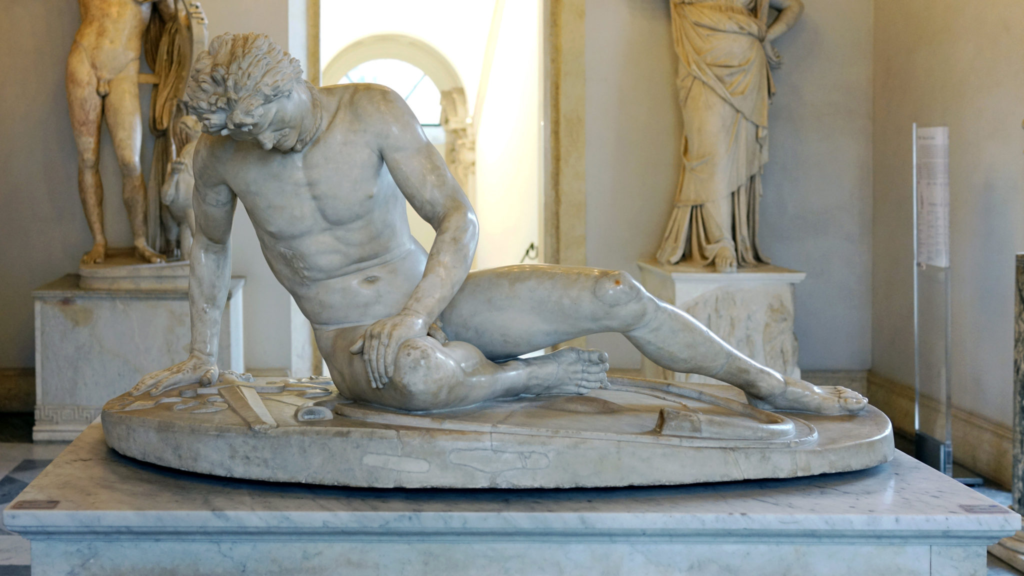
Currently housed in Rome’s Capitoline Museum, The Dying Gaul (230-220 BCE) is a Roman marble copy of a lost Greek bronze. Originally displayed on the Altar of Pergamon, in what is now modern-day Turkey, The Dying Gaul is a powerful example of Greek Hellenism. Part of a larger sculptural series on the Altar of Pergamon that also included The Ludovisi Gaul, the work was created to commemorate the Pergamene victory over the Gauls, an intent reflected in its poignant portrayal of a defeated Celtic warrior moments before his death. By not portraying themselves or their god, but a dying enemy, the Greeks revealed a shift in cultural identity and artistic values–one that embraced emotional depth, human vulnerability, and the power of empathy.
The depiction of warriors was common in Ancient Greek art, however, the approach taken with the Gauls was notably different. The Gauls, or Galatians, were Celtic peoples who migrated from Western Europe to Asia Minor, playing a significant role in the geopolitics of the region during the Hellenistic era. The sculpture’s subject is identifiable as Gallic by his torque (a twisted neck ring typical of Celtic warriors), along with his bushy hair, prominent mustache, and his strikingly muscular, nude form–a stark contrast to the clean-shaven, idealized aesthetic of classical Greek figures. These features conform with ancient literary accounts, such as those of Polybius and Diodorus Siculus–Greek historians writing in the Hellenistic and Roman periods–who emphasized the fearsome appearance and courageous nudity of the Gauls in battle. The Greeks, though they feared the Celts, also admired their bravery, a complex sentiment that influenced how this figure was portrayed, blending both reverence and apprehension in its representation.
Unlike the traditional triumphal monument of antiquity that glorified the victors, The Dying Gaul offers a rare sympathetic portrayal of the defeated. This artistic choice marks a significant shift in the Greek understanding of heroism and human condition. Rather than exalting the conqueror, the sculpture calls upon viewers to acknowledge the cost of war and the nobility of an enemy who met death with dignity. The Gaul is depicted not in agony, but in quiet resolve, collapsed upon his shield, with his broken sword and trumpet nearby. Blood flows from a wound in his side, yet his body remains composed, holding himself upright in a final moment of strength. The visual tension between his idealized form and his impending death speaks to the Hellenisitic interest in realism and emotional expressiveness–a marked departure from the stoic perfection of Classical sculpture. This is evident in the work of the sculptor Epigonos, whose style, marked by dramatic realism and emotional intensity, captures both the raw vulnerability and strength of his subjects, reflecting the Greek admiration for both heroic valor and human fragility.
Formally, the sculpture is masterfully executed. The anatomy is rendered with precise attention to the musculature, yet the body is slumped, heavy with the weight of mortality. The contorted posture of the Gaul’s torso twisted in a spiral movement and his head tilted downward, creates a dynamic composition that demands the viewer interact with the figure. His face, though beautiful, displays strain and resignation…his furrowed brow, parted lips, and distant gaze speak of physical pain and emotional defeat. This coupling of physical strength and human vulnerability invites the viewer to empathize with the fallen warrior, transcending cultural boundaries and challenging the contrast between the civilized and the barbaric.
The original bronze sculpture was likely commissioned by King Attalos I of Pergamon to commemorate his victory over the Gauls. Art historians, including Dr. Steven Zucker and Dr. Beth Harris, have emphasized that the monument is focused solely on the defeated, suggesting a deliberate effort to recognize the enemy’s sacrifice. Literary and epigraphic evidence, including an inscription found in the sanctuary of Athena at Pergamon, links the creation of such works to the sculptor Epigonos, under whose name offerings of thanks were dedicated to Zeus and Athena for victory against the Gauls. Pliny the Elder, a Roman author who wrote the Natural History (an encyclopedic work of human knowledge and the natural world), later described a “Trumpeter” by Epigonos. This claim supports the idea that The Dying Gaul–whose trumpet lies entangled between his legs-may be that very statue.
That the Romans later copied these works into marble and brought them to Rome, possibly during the rule of Emperor Nero, underscores their enduring symbolic value. For both the Pergamene Greeks and the Romans, the subject served a dual purpose: to mark a military victory and to affirm the triumph of civilization over barbarism. Yet the emotional gravity of the sculpture complicates this dual message.
The choice to center a non-Greek figure reflects a broader shift in Hellenistic art towards individualism and psychological depth. As the Greek empire expanded its borders and encountered diverse cultures during the Late Classical era, art followed suit, embracing human stories, especially those marked by suffering and resilience. The Dying Gaul transcends simple propaganda. It is not merely a relic of nationalistic pride; it is a reflection on courage, death, and empathy. By portraying the fallen warrior with such dignity, the Greeks—and later the Romans—humanized their adversaries, suggesting an awareness of shared mortality and valor across cultures.
However, this interpretation is only one layer. The Gaul’s vulnerability and defeat could just as easily serve as a warning. The sculpture is not only a mirror but a message: this is what happens to those who resist the empire. In glorifying the fallen enemy, the Greeks and Romans may have reinforced their dominance by offering viewers a stark visual of noble resistance crushed under imperial power. In this reading, the “Other” is both honored and subdued—admired for his bravery, yet ultimately a symbol of submission. It is art that walks a fine line between empathy and intimidation, between cultural recognition and assimilation.
Ultimately, The Dying Gaul is important not only for its historical context or artistic innovation but for its profound humanism. It stands as a monument not to the glory of conquest, but to the solemn beauty of sacrifice. Through its compelling visual and formal language, the sculpture challenges viewers to reflect on the humanity of enemies, the complexity of cultural identity, and the eternal interplay of beauty and suffering. As such, it remains one of the most emotionally resonant and intellectually provocative works of the ancient world.
Bibliography
Arensberg, Susan M. The Dying Gaul. National Gallery of Art, October 15, 2013. https://
www.nga.gov/content/dam/ngaweb/exhibitions/pdfs/2013/dyinggaulfinalbrochure.pdf.
Cassibry, Kimberly. The Dying Gaul, Reconsidered. Smarthistory, May 13, 2023. https://
smarthistory.org/the-dying-gaul-reconsidered/.
Harris, Beth, and Steven Zucker. Dying Gaul and Ludovisi Gaul. Smarthistory, November 18,
2015. https://smarthistory.org/dying-gaul/.
Stewart, Andrew F. Epigonus. Oxford Classical Dictionary, 22 Dec. 2015, oxfordre.com/
classics/display/10.1093/acrefore/9780199381135.001.0001/acrefore-9780199381135-e-2447.
The Editors of Encyclopaedia Britannica. Gaul. Encyclopedia Britannica, November 23, 2024.
https://www.britannica.com/place/Gaul-ancient-region-Europe.
University, DePauw. The Dying Gaul. DePauw University, June 25, 2013.. https://
www.depauw.edu/academics/departments-programs/classical-studies/gallery/the-dying-gaul/.
